The cuts continue (…and my nerd heart breaks a bit)

The following excerpt was written during the early stages of the novel. It’s based on an actual event that I remembered from the late ’90s (and you might as well if you lived in Ottawa back then), memories that were remarkably well corroborated when I eventually unearthed the story from CBC’s website 2 decades later.

I deleted the passage from my novel with a pang of regret. I love what it tells about my narrator, Justin, to say nothing of the fact that the anecdote it recounts is a very apt metaphor for the character of Billie. In the end, however, the voice was wrong. When I began writing the novel, my narrator was a teenager, but as the story  came together, I found that I needed to put more distance between the storyteller and the events he describes. Justin became a young adult, a 22-year-old looking back at the events of his childhood, and this passage no longer fit.


*****

I’m a bit of a bird-nerd, with the emphasis on nerd. It’s something I picked up from Dad.

Dad has always said that nerds should be celebrated, because they’re so positive and excited and passionate about things. They just like stuff. If nerds should be celebrated, then my dad deserves a monument. He’s the über-nerd, the Ur-nerd, the nerd to end all nerds. He taught science, history and English at my school, and his students loved him. The thing the other kids said the most about him is that he really got excited about the stuff he taught, and that it was funny sometimes. I can well imagine that’s true because on those occasions when he was in the right mood, he did the same thing at home. I didn’t mind because his enthusiasm always made everything so compelling. Dad loves just about everything: he can talk forever about space, nature, history, and art; ancient civilizations, ruins, wars and kings; bones and fossils and the creatures they came from; planets, moons, stars, galaxies, and black holes; trees and plants and insects and creepy-crawly things; art and architecture and literature and music and language; and though I would sometimes tune out, he’d even talked to me about politics and current events.

Dad has taught me to recognize and appreciate stuff that a lot of people wouldn’t notice or even care about. I knew how to identify the constellations when I was seven, and I knew my dinosaurs even earlier. Dad says that being able to see and identify things in the world is a lot like collecting stuff (like stamps or coins or shells or whatever) only better because it doesn’t cost anything and doesn’t take up space in your house. One thing that he was really good at, and that I took to as well, was identifying birds. He started with me when I was little, and one of the best birthday presents he ever gave me was Peterson’s Guide to Birds of North America. The next year he got me a pair of binoculars, and then a few years later a better pair. Apparently it wasn’t an interest Mom shared with him, and I guess he wanted to make sure he’d be able to talk to someone else about it. It was fun and easy enough because there weren’t that many different kinds of birds where we lived (though more than you might think). I even taught myself their scientific names: my favourites were the the Banded Kingfisher, Ceryle alcyon, the Snowy Owl, Nyctea scandiaca, and the Eastern Kingbird, Tyrannus tyrannus. To this day, one of the things I do whenever I travel is to see how different the birds are from those at home. It’s not like I drag my Peterson’s around everywhere like I used to (it’s pretty old and dog-eared by now). I’ve got to the point where I can pretty much identify everything in my neighbourhood. Still, those rare times when you see something that you’ve never seen outside of the book are pretty exciting — the first time I saw an oriole, I totally stopped breathing for a minute — and I love that my dad really gets that.

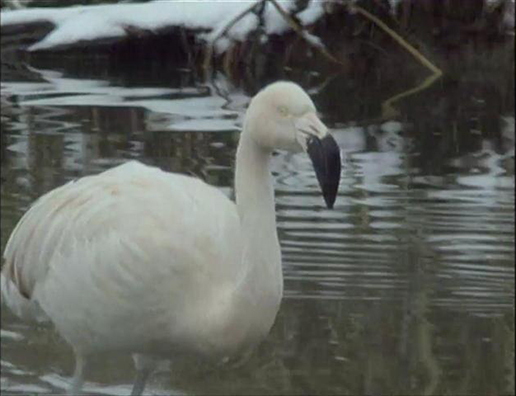
There was a story that ran in the news when I was very young about a flamingo that suddenly appeared along the banks of the Ottawa River, in Nepean, Ontario. For three weeks there were sightings here and there but every time someone tried to get close it flew away, only to be spotted again a few hours or days later in another pond. There was a lot of fuss about it at the time, and my dad was totally fascinated. Nobody could figure out what it was doing there, and a lot of people (my dad especially) were worried that it would freeze to death (this was in November), or die of starvation from not being able to find its regular food. Most of the migratory birds, like herons and Canada geese, had long since left for warmer places, and the images in the local media of this poor flamingo standing all alone in freezing cold water, looking utterly miserable so far from home, were heartbreaking. Eventually, the story made the national news, which was when the manager of a bird sanctuary in Connecticut (some 650 km away) finally recognized it as a bird that had gone missing weeks before. By then the flamingo was pretty weak, and when the manager from the sanctuary went to capture it and bring it home, the flamingo didn’t so much as flap its wings. It simply let itself get wrapped in a blanket, gathered up in the lady’s arms, and taken away to safety. I love happy endings.
flamingocaught

“Looking a bit pale. Maybe some sun…”

What was most compelling about that story was how out of place that poor bird looked. I watch nature documentaries all the time and whenever they show flamingos, they’re gathered by the tens of thousands on some warm, green tropical lake. Yet there it was, standing all alone in a cold pond in the outskirts of Ottawa, completely out of its element. There was something distinctly wrong with that picture, beyond the fact that it was an exotic bird in such a cold and gloomy place. I’ve never heard it quite articulated this way, but when I think back on it, something was taken from this beautiful creature. It seemed somehow lessened for being there: less graceful, less exotic, less pink even.

It was an outsider, stranded by happenstance in a place it wasn’t adapted to. Had that event occurred during the summer of ’06, I might have made a very different assumption.

65 Million Years is a Long Walk

As it appears that my manuscript (currently at 150,000 words, give or take) would benefit from a substantial trim, I am sharing a passage that was a late addition to the novel and that I’ve since excised. (There will likely be a few more of these in the coming weeks: there’s a lot to cut.) It’s actually based on a lesson I once gave to a group of school kids, with the idea of providing them with a very rudimentary but tangible understanding of what geologists call deep time, that is time as measured in thousands of millennia.

*****

Dad had a great way of getting his students to understand deep time.

He used the tiles on the floor of his classroom, which conveniently measured about a foot square. Each linear foot, one tile length, would represent 1000 years of history, so six inches would be 500 years, three inches would be 250, an inch and a half 125 years, and (again, conveniently) one inch would be about an average human lifespan, about 83 years. He would then populate that line with events that came up in History class. So for example, when I was 12 in 2006, if you went back one inch or so you’d be in 1923; three inches would take you roughly to the Acadian Deportation and the fall of New France to the English; six inches was around the time of the Spaniards landing in the New World; and a whole foot would take you roughly to the time of the Norse in Newfoundland, the Battle of Hastings and the Norman Conquest, and the first Crusades.

Print

(placement of events is approximate)

Obviously, the more a person knows about history, the more significant landmarks you can place on the timeline. Two feet and you’re already at the time of Christ and the Roman Empire; three feet (one adult stride) and you find yourself in 1000 BC: you’ve just missed the Trojan War and the reign of Ramses the Great in Egypt. Four feet and Stonehenge is built; the Great Pyramids of Giza are at four and half feet, and at five feet writing is invented. If you go back 10 feet, a third of the way across the classroom (a bit more than 3 strides), you’re at the end of the last Ice Age: the last of the mastodons and giant ground sloths and sabre-toothed cats become extinct in North America, and humans in the Middle East have just begun to cultivate plants for the very first time. The famous cave paintings of Lascaux in France are 17 feet away, while those of Alta Mira in Spain are at 36 feet, about the length of a typical driveway.

Print

“So class,” he’d say “At this rate, with 1000 years going by with each foot you walk, how far would you have to go before you got to the extinction of the dinosaurs?”

Answers would vary. To the door? Out the door and down the hallway? All the way outside to the parking lot? Maybe one brave soul would suggest down St. Joseph Street to the Centre Street intersection, which would generate a few muffled snickers. The correct answer never failed to surprise.

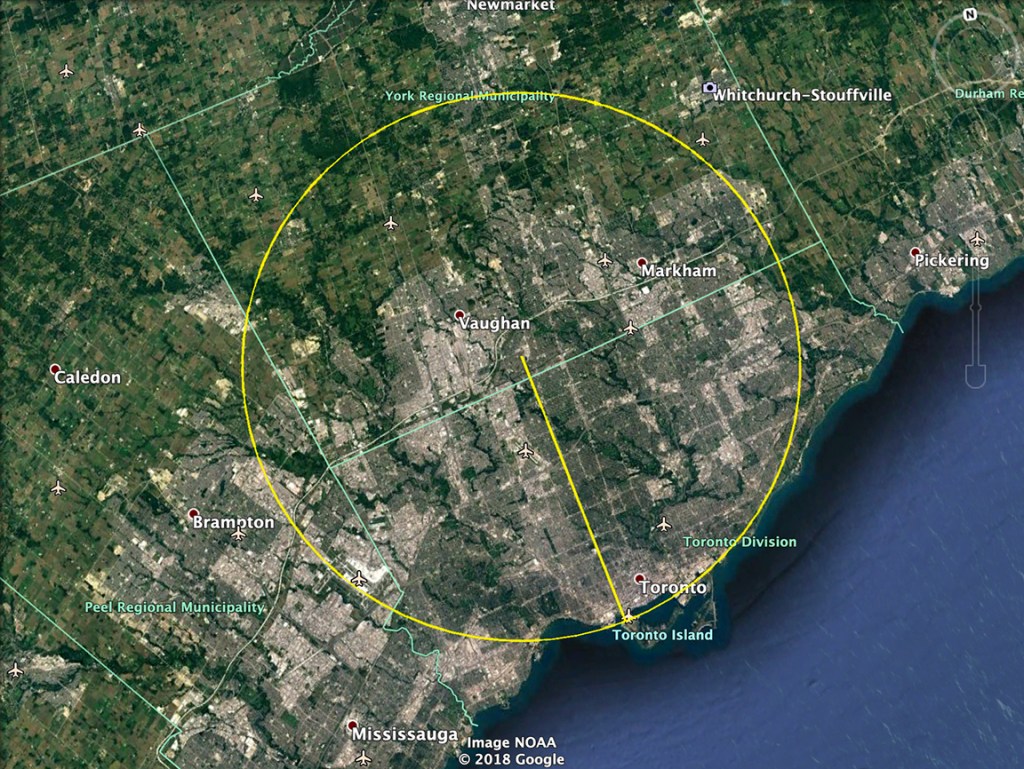
“In fact, you’d have to go 12 and half miles, or 20 km.”

satellite_shot

… and now you know where I live.

Of course the dinosaurs were around for 165 million years, appearing in the Triassic about 230 million years ago. If you wanted to go back to their beginning, you’d have to travel 43.5 miles, exactly 70 km. And as far as life on earth goes, you’re just getting started: 60 miles (96 km) to the first reptiles, about 90 miles (144 km) to the first land plants, 100 miles (161 km) to the first fish, and more than double that again to the very first bacteria.

Finally, if you have time for a bit of a trek, you can go back to the formation of the planet 4.5 billion years ago, about 852 miles (or 1,371 km). To put that in perspective, it would be like walking in a straight line from downtown Toronto to eastern Nova Scotia or, alternatively, to the Ontario/Manitoba border.

“It’s an old, old world folks,” Dad says. “Humans have only been around a short time, just long enough to get comfortable. But the earth takes its time and it has no plan. There’s no particular way things are supposed to be: the world is the way it is until something happens, and then it’s different. And it’s not going to ask our permission.”

A word about maps

I’m lucky in having a pretty reliable sense of orientation. It’s in my DNA, along with my inherent skepticism and my susceptibility to sunburn. I’ve always been able to find my way; even as a little kid I had an uncanny sense of direction for someone who didn’t drive. I learned early on how to navigate by the sun and to know where my compass points were at all times. Of course, I can get lost with the best of them if I’m in the dark and get turned around in a place I’ve never been, but that notwithstanding, my mental maps rarely let me down.

I’m not sure whether my enthusiasm for maps is a cause or a consequence of this attribute, but I’ve always been drawn to them. I love books with maps, and I refer to them constantly. Growing up, all my favourite books had maps (and not just the fantasy novels either), so it was a bit of a no-brainer that I’d develop a map of my fictional town of Ferguston. There was no shortage of reasons.

First, it was critical that the spatial relationships, distances and features in my novel were completely logical, realistic, and (most of all) consistent. It had to seem REAL. What does a town of this size look like? Is the scale correct? Does the layout of the town make any sense? Is it in keeping with existing towns of the same size and general region of the country? Also, the movements of my characters are extremely specific: head down this street, make a right, continue for two blocks, make a left, that kind of thing. Is the time allotted to get from A to B realistic, and how is this affected by the geography?

The importance of these considerations was something I understood intuitively (one of the few upsides of an obsessive personality), and I referred to the map continually as I was writing, adjusting and fine tuning it as necessary. But there was more to it than that. The Perpetual Now contains a lot of detail related to setting, detail that is at once historic and geographic. In fact, Ferguston is as much of a character as any human being in the novel, with its own past, its own personality, its own idiosyncrasies, and I wanted my readers to recognize it, connect it with actual towns they know or have been through. In creating Ferguston, I was looking for more than mere believability; I wanted familiarity.

Finally (as Toni Morrison once said) I wrote my novel because I wanted to read it, and it was therefore going to have a map, if only for my own selfish pleasure. There’s a deep satisfaction in creating a world, even a small one, and drawing a map of a fictional setting is the most immediately tangible aspect of worldbuilding, otherwise known as playing god.

Map of Ferguston

As befitting northeastern Ontario, street names are English, French and Scots, with the exception of the neighbourhood of Ridgeview, a newer housing development where the streets are named after all the trees that were cut down to build the subdivision in the first place.

The Waiting…

clocks

Turns out, the life of a writer has parallels with an actor’s life. Both involve a similarly agonizing process of submitting and waiting. While an author submits a manuscript to a publisher or a query letter to a literary agency, an actor submits a request for an audition, then waits for a response. If the audition comes through, you wait for a callback, after which (should you be so lucky) you wait for a final casting decision. If you have an agent, they usually handle the submission process for you, although you do submit independently at times and end up waiting anyway.

One of the hardest things I found about being an actor was learning how to forget about the audition for which you just spent days (sometimes weeks) preparing. “Just put it out of your mind,” you’re told. Oh sure. If the audition goes poorly it’s not so hard to do, but if you nail it, you’ll be reliving every moment for days despite your best efforts and better judgement. And the wait is horrendous. With each passing hour, day, week, a positive outcome becomes less likely, and yet you believe you still might get the call because you neeeeeeed to believe.

And so you wait.

TomPetty_Waiting

This guy might have been onto something…

The first week is the worst. You keep your phone within reach at all times because good news is usually called in, while bad news invariably comes via email. As time ticks by you may start to use half-assed psychology on yourself: if I leave my phone where I can’t get to it, it will probably ring, because a watched pot and all that. Or you try to calculate the ever-diminishing probability of good news based on the shooting or rehearsal schedule: if the shooting/rehearsal date is imminent and you’ve heard nothing, you can probably throw in the towel and think about something else. Conversely, if the production isn’t getting started for another x number of weeks or months, you tell yourself there’s still room for optimism. If you don’t hear right away, the next best case scenario is to get the good news only after so much time has passed that you have to be reminded what the project was in the first place. Such episodes happen on occasion and are directly responsible for all this delusional optimism.

In my acting life, I’m currently waiting for answers on a number of projects. One (a part in a short film), has mercifully come and gone. Another (a TV crime drama) has so far involved a self-taped audition, followed by a 5-week wait, followed by a call-back and another separate audition for a different part, followed by another 5-week wait. Still no word (my agent is investigating). Finally, I’m waiting for an answer on a stage audition that took place last weekend; hope is fading fast on that one, although rehearsals aren’t set to begin until July.

And so I wait.

Writing, I’m learning, is similar. In the past month I’ve sent query letters to a handful of literary agencies, my first call-out to the publishing world that I’ve written a novel. A few sent confirmations of receipt, others didn’t. In their submission instructions, most agencies suggest it could take anywhere between 4 weeks to 3 months before they respond, if they respond at all. And it will be much longer still when I submit the actual manuscript (whether to agents or directly to publishers), easily up to 6 months.

And so I —

Wait! Is that my phone?…

Who should play the part of…

OK, yes, I’ve been away a while (4 months, but who’s counting?). I neither died, ran off on an extended writer’s retreat, won the lottery and decided on early retirement, joined the touring company of Les Misérables, or found a real job. So why the radio silence? Call it a combination of writer’s block and real life rearing its ugly head and requiring my attention (… that’s my story anyway and I’m sticking to it).

And yes, I will go back to writing about what has been going on as far as my novel is concerned (ostensibly the purpose of this blog), about new ideas for stories, research, and writing query letters for literary agents. BUT, as Aragorn said before the black gates of Mordor, it is not this day.

Instead, I’m going to have some fun sharing my latest obsession. With the never-ending soap opera/train wreck/circus freak show that is the current White House monopolizing headlines this winter, I’ve been amusing myself with a bit of speculative casting for a potential (inevitable?) movie or mini-series on the Trump administration.

I tried to be as original as possible and avoid knee-jerk casting, i.e. choosing actors already known for their popular impersonations (à la Alec Baldwin as Trump or Tina Fey as Sarah Palin). On the other hand, it turns out that some of my choices concur with those of other people who have speculated on a Trump film (and they are many), and I’m not going to change my mind just because I’m in agreement with someone else. In some cases there’s an obvious physical resemblance (see my choices for Paul Manafort and Sean Hannity, for example), but being a doppelgänger doesn’t necessarily carry the day. I’m looking for a certain characteristic about the actor that I find suitable, a certain je-ne-sais-quoi that overrides physical resemblance. That’s certainly the case with my first choice:

Donald Trump: Val Kilmer. Yes, you read that correctly. Now before you scoff at this one, consider a moment. Yes, he’s a bit young, but there is physical potential; I mean, have you seen Val Kilmer lately? Kilmer has also proven he can don someone else’s skin very effectively, and he has a certain mercurial quality about him (some would say he’s a bit of a whack job himself) that could translate well in portraying 45. Hell, you didn’t think he could play Batman either (… OK, bad example).

Robert Mueller: Sam Waterston. The man is the embodiment of integrity. Mr. Law & Order. If he hadn’t chosen acting, I’m sure he would have been a real-life district attorney. Second choice: James Cromwell.

Hilary Clinton: Annette Benning. She conveys intelligence, strength, and bears an (albeit idealized) resemblance.

Nancy Pelosi: Diane Lane. Ditto, plus she has a raw toughness that I like (see Clark Kent’s mom Martha in Man of Steel.)

Michael Cohen: David Schwimmer. Loveably detestable.

Paul Manafort: Mike Myers. The resemblance is actually striking, and Myers plays a good slime ball.

Roger Stone: Steve Martin. A wacky comic actor to play an even wackier comic-book villain. (Stone himself could be cast in the role of the Penguin in the next Batman film.)

Steve Bannon: Brendan Gleeson, Ray Liotta or Ian McShane. All this wonderful potential, and only because Philip Seymour Hoffman is no longer available.

Mike Pence: Steve Carell. This might be a waste of talent on a character who could be played alternatively by a block of wood, but Carell can do dead-pan like no one else.

Kellyanne Conway: Holly Hunter. I ADORE Holly Hunter. Strong, intelligent, tough, normally someone I want to cheer for, but she could play the sycophantic nitwit just as effectively. This would be the antithesis of the character she played in Broadcast News, and would be great fun to watch.

Sean Spicer: Gary Sinise. A straight-shooter, a real-life Republican, and a guy who seems to take himself awfully seriously; also just the right height. Alternatively Martin Freeman or William H. Macey, if you’re looking for a funnier portrayal.

Bernie Sanders: Alan Arkin. Forget Larry David: Arkin is a much more serious actor with more gravitas than David could scrape together in a lifetime. Great voice. Also, another Brooklyn native.

Jeff Sessions: Chris Cooper. A little tall for the part and not the Keebler Elf type, but a serious actor and an authentic Southern man with lots of potential bile.

Michael Flynn: Stephen Lang. Much more threatening than the real Flynn, and has long and successfully portrayed the high-ranking military man (see Avatar among others). Looks good in a crew cut.

Melania Trump: Elizabeth Hurley. Better looking than Melania, and — more importantly — she can be extremely funny; alternatively Rachel Weisz, who can do ANYTHING!

Ivanka Trump: Jessica Alba. Physical resemblance (same lovely smile and vacuous stare); perfectly anodyne, wholesome, like a tall glass of soy milk.

Donald Trump Jr.: Ben Stiller. Like David Schwimmer, only less loveable.

Eric Trump: Martin Wallström. As seen in Mr. Robot, a cold, nerdy evil.

Jared Kushner: Michael Cera. A bit of a goof, but would make a hilariously incompetent villain.

James Comey: Michael Shannon, Dillon Baker, or Liev Schreiber. This is a tough one: none bear much physical resemblance to Comey, though Schreiber and Shannon have the advantage in height. All have gravitas and fit the part of the betrayed true believer. (Baker was really born to play former Defence Secretary Robert McNamara, but that’s another film).

Rex Tillerson: James Brolin. Don’t be fooled by the awkward, goofy grandfather role in Life in Pieces: a physically imposing figure, intelligent but completely out of his element. Alternatively Sam Elliott.

Gen. John Kelly: J.K. Simmons. Hands down: could almost be Kelly’s twin and is a scary SOB in his own right.

Sarah Huckabee-Sanders: Melissa McCarthy. The role requires a superior comic actor. McCarthy would be outrageous.

Betsy DeVos: Jane Lynch. One of the funniest and most under-valued actresses in Hollywood. I originally thought of Christine Baranski, but she’s just too fabulous to be that wonky.

Ben Carson: Damon Wayans. Wayans would be lethal in this role. Also Clark Peters (The Wire), or Eddie Murphy in a pinch.

Sean Hannity: Nathan Lane. Another great comic talent to play a cartoon figure, and there’s the uncanny physical resemblance.
There you have it. You may have other ideas. You may have BETTER ideas. I’d love to hear them. Please leave a comment and let’s get this argument started!

Trials of a Teenage Skeptic (part 3: the struggle continues…)

Sadly, my hopes for a general trend toward reason and critical thinking weren’t validated in the years following high school. Being a skeptic isn’t any more popular among grown-ups. Because they’re seen to undermine at times what appear to be really fun ideas, people see skeptics as boring or uninspired, or that they stifle the imagination (which as a writer of fantasy I can say is completely unfounded — see Part 1 of this post).

Others will say that skepticism goes against the cherished principle of open-mindedness, forgetting the fact that being open-minded is merely the willingness to consider evidence, not the willingness to accept claims without any. In the most extreme cases, anything goes, and you get instances (as I once heard to my horror!) of university professors — in the spirit of fairness and open-mindedness — upholding even the possibility of mermaids living in the world’s oceans.

ancient-aliens-1_0

to say nothing about this guy…

And let’s not kid ourselves that this systemic lack of critical thinking culminates with a membership surge in the Flat Earth Society and a few bad documentaries on the Discovery Channel. It’s far more insidious and destructive, ultimately leading to where we are now: in an endless sea of scams, fake news, and “alternative facts”, where critical thinking is abandoned for anti-intellectualism, reason swapped for fantasy, fact for feelings. Ultimately, and most disconcerting of all, it ends with an uncritical public electing ignorant leaders who dictate uninformed and reactionary public policy. [Read Kurt Anderson’s excellent article How America Went Haywire for a detailed history of this process.]

Yes, it’s a hard time to be a skeptic, and we’ve never needed them more.

Trials of a Teenage Skeptic (part 2: a case in point)

Back in the ‘70s, there was a movie called Chariots of the Gods? that generated a certain amount of noise. Based on a book by Erich Von Däniken, it was ostensibly a “documentary” that looked at how the ancient world was directly influenced (and, in many cases, actively shaped) by extraterrestrials: guiding early civilizations in the building of pyramids and other monumental works, appearing in prehistoric art, instructing our forebears in the workings of alien technology, etc. No claim was too outlandish, no piece of evidence too flimsy. If evidence was missing, the filmmakers would simply make it up.

sagan

The film’s pedigree was dubious from the start, but that didn’t seem to bother audiences. Despite the fact that the book’s author was accused of plagiarism and for manufacturing evidence, or that he had a lengthy arrest record for theft, fraud, forgery, and embezzlement, or that the book was co-written by a well-known Nazi propagandist, or that Von Däniken himself had no background whatsoever in either history, archaeology, or science and that his claims were choked with baseless assumptions and factual errors, or that he casually dismissed centuries worth of research by countless dedicated historians and scientists from around the world, or that his entire premise that people of ancient Egypt, the Americas, Mesopotamia, South and East Asia, Oceania, and the South Pacific (he gives Europeans and Christianity a pass, somehow) were intellectually incapable of achieving great works of architecture and engineering (or even non-representational art) was inherently racist and eurocentric, the book and the movie were colossal international hits. Von Däniken’s books collectively have sold over 70 million copies, while the movie grossed just under $26 million in the US alone and even earned an Oscar nomination for Best Documentary Feature. (*Sigh*)

In 1976, Carl Sagan wrote:

That writing as careless as von Däniken’s, whose principal thesis is that our ancestors were dummies, should be so popular is a sober commentary on the credulousness and despair of our times. I also hope for the continuing popularity of books like Chariots of the Gods? in high school and college logic courses, as object lessons in sloppy thinking. I know of no recent books so riddled with logical and factual errors as the works of von Däniken.

The film was hugely popular in classrooms, but not for the reasons Prof. Sagan had hoped for, unfortunately. I can personally attest to that. Even as a teenager I knew how full of shit it was, and I remember despairing that this contemptible piece of celluloid birdcage liner should be taken for a legitimate documentary.

Any hopes that the teacher would show some degree of critical analysis, the kind of thing I’d grown to
expect from adults, were instantly quashed.
In fact, he held a show of hands to determine
the likely veracity of the film

My teachers and classmates, on the other hand, gobbled it up; it was all they could talk about for weeks. Worse yet was the reaction I received when I timidly expressed my reservations about the film (a feat in itself, given how shy I was as a kid). “You’re boring!” “You’re closed-minded!” “You have no imagination!” “You don’t know everything!” or my personal favourite “You just choose not to believe!” Of course, I was a kid and I didn’t have all the answers, nor was I so sophisticated that I could systematically take down every argument that was thrown at me (including that belief was completely irrelevant to the issue), but it didn’t help that I got no support from anyone, let alone the one adult in the room. Any hopes that the teacher would show some degree of critical analysis, the kind of thing I’d grown to expect from adults, were instantly quashed. In fact, he held a show of hands to determine the likely veracity of the film, and felt completely vindicated when everyone but me declared themselves to be in full agreement with it. It was a refrain I’d heard before and would hear over and over again: “X number of people can’t be wrong, you know.” Put another way, “The truth of an idea is determined its popularity.” This from a high school history teacher. (*Another sigh*)


[Next in Part 3: The struggle continues]

Trials of a Teenage Skeptic (part 1 of 3)

Much of The Perpetual Now has to do with skepticism, and like my central character, Justin Lambert, I owe mine to my family. I certainly didn’t learn it in school. I’m what you’d call a born skeptic; call it a genetic predisposition. Since before I entered high school I had already begun to assemble what Carl Sagan politely dubbed a Baloney Detection Kit, also known as a bullshit meter. In my family, all manner of sensationalist claims (be they UFOs, mythical monsters, astrology, the paranormal, etc., etc.), old wives’ tales, superstition, shameless propaganda, outrageous conspiracy theories, and flat-out nonsense were met with a firewall of reason and almost draconian scrutiny. I picked it up through osmosis and it became instinctual. It also did nothing to improve my popularity at school. Throughout middle especially, I was a poorly dressed introverted version of Ross Gellar living an endless teen episode of Friends 20 years before it came out.

[Before I go further, a caution. As a writer, I love to let my imagination take flight, and it regularly transports me to wild and wonderful places, places that defy description. It’s how my novel was born. Fantasy, sci-fi, horror, and speculative fiction make for fabulous stories, and telling stories is one of the things humans do best. It is fundamental to our nature. But stories are just that: stories. They have purpose, they teach us, they inspire us to reach beyond, but they are in the end just stories. I know enough not to get them confused with reality. I can write a wonderful fable about a unicorn, and if I do my job right, the story can touch people, inspire people, make people wonder and laugh and cry and think, but that doesn’t mean I’m going to launch an expedition to find one.]

It’s one thing to be a nerd; it’s a whole other to be a skeptic. A skeptic is a nerd who doesn’t believe in little green men. The skeptic is seen by many as the embodiment of a bucket of cold water. In popular culture, the skeptic is portrayed as the naysayer, the “so-called” expert, the nerdy know-it-all who’s trotted out to tell the hero that what they saw is impossible, what they believe is nonsense, and what they plan to do is futile, until that moment when the skeptic himself is proven wrong, usually as he’s being eaten or otherwise undone by the very object of his skepticism. Ironically, the reason the skeptic is included in the story in the first place is as a perfunctory nod to science, providing the story with a much-needed element of credibility that only science can provide, right up until the moment when science and reason become inconvenient to the narrative.

Of course feature dramas are one thing: they’re pretty easy to write off, especially when they’re badly done. “It’s just a movie! No one is trying to convince you it’s real. Don’t take it so seriously!” Hell, even a skeptic can suspend disbelief once in a while. Documentaries, on the other hand, are different: there’s a tacit acceptance that the filmmakers have done their homework, that what they have to say is important and can be supported by evidence, and that they have at least some measure of integrity.

Alas, they don’t always.


[Coming up in Part 2: A case in point]

interlude

A short missive about inspiration.

This past Thanksgiving Day long weekend, my far-better half and I ventured to Prince Edward County, south of Belleville, Ontario. The idea was to spend a few days touring the wineries (which are legion in the region), have dinner at a couple of nice restaurants, and take in an art gallery or two. We ended up visiting several galleries, and while the talent exhibited was undeniable, the few works in which we were in complete and full agreement were plainly out of our price range. By Monday we were prepared to return home empty-handed (it wouldn’t have been the first time), when during a last-minute visit to Arts on Main (an artists’ cooperative in Picton) we stumbled upon this.

MoonRising_sm

Moon Rising is by Picton artist Barb Högenauer. [You can see her some of her other works at www.countystudio.ca] The piece is done in cold wax medium and oil. I fell in love with it instantly. That doesn’t happen often.

I could go on about what it was about the painting that stopped me in my tracks (the intensity of colour, the texture, the contrast, the almost mathematically perfect composition), but what sold me from the first moment were the stories it evoked.

I started off as a visual artist: my primary source of inspiration in those early days was simply good art. As a graphic designer, the same principle held: good design made me want to create good design. The same with acting, the same with sculpture, hell, the same with cooking. As a writer, however, inspiration is far, far more arbitrary, diverse, random and unexpected. It can come from anywhere at any given moment: good writing (obviously) inspires me to write, but so can a great film (or a bad one), a piece of music, lyrics to a song, street art, an odd building or quirky feature on a landscape, a random individual on the subway, a stray comment overheard at a gas station, even a single image or a clever meme on Facebook, to say nothing of personal experience, events local or far flung, and dreams (waking or otherwise). [This is not to say that visual artists, musicians, and actors don’t benefit from a diversity of inspirational sources, but this blog is partly about my discoveries as a writer; and while it’s one thing to read about what may light your creative flame as an author, it’s a whole other to live it first hand.] For the instinctive storyteller and compulsive communicator, someone with a half decent eye for detail and a runaway imagination, all of these sources can and will provide the beginnings of storylines, settings, conflicts, and characters.

The painting we purchased in Picton on Monday has that power, at least for me. One glance in the gallery and it immediately started telling me stories. There is mood. There is atmosphere. There is movement (don’t believe me? look at the trees). There’s a sense of isolation, of scale, and even a sense of temperature. And there is a presence, possibly lurking somewhere in the woods but most definitely in the little red house. From my vantage point as a viewer, I’m drawn by what may be down in that cold dark forest clearing; I want to know who or what lives down there, but I somehow want to be careful about finding out.

Part of the purpose of this blog, in addition to talking about my novel, my process, and my revelations as a writer, is to serve as a landing place for new works of short fiction. I suspect something in Moon Rising may have hit a switch, got the machine grinding and chugging, setting something in motion.

Watch this space: things are stirring.


The Perpetual Now: Dramatis Personae

An annotated and (almost) complete listing of the characters in my novel.

Justin Lambert: Narrator. Resident of Ferguston, Ontario. Aged 12*. Son of Martin Lambert, a teacher at St. Marc public school, and Élise François, emergency physician, missing since 1996. Above average intelligence. Biracial. Introvert. Skeptic. Atheist. Voracious reader. Interests include: science (esp. astronomy, palaeontology, archaeology), sci-fi, jazz music, coffee, writings of J.R.R. Tolkien. Quiet, serious demeanour bordering on grave. Avid cyclist. Beginning to discover girls. Few close friends. Worships his dad, longs to be closer.

* Justin narrates the story as an adult, reminiscing on the events of 2006 when he was 12.

Martin Lambert: Father of Justin, still-grieving husband of Élise François, who has been missing since 1996. Younger brother of Carl Lambert, a lawyer from Sudbury, and two sisters. Teaches English, History and Science at St. Marc, a French-language public school in Ferguston, Ontario. Skeptic and critical thinker. Atheist. Interests are deep and vast; can speak knowledgeably and enthusiastically on almost any subject. Extremely popular at school and beloved member of the community. Along with his son, has become something of a celebrity because of his wife’s disappearance. Has an open friendly demeanour in public, much quieter, almost taciturn at home. Will occasionally drift off and become momentarily detached from people and events around him. Huge fan of psychedelic music from 1960s. Avid jogger.

Billie: A girl of approximately 10 years of age; date of birth unknown. Close friend of Justin Lambert. Last name unknown. Parents unknown. Address unknown. First seen in Ferguston on Friday, May 12th, 2006. Extremely high intelligence, although surprisingly naive on a number of subjects. Feisty, at times argumentative. Interested in everything. Highly tactile. Extremely shy in the presence of adults. Smells vaguely of cinnamon. Oddly feared by animals. Worships Justin. Last seen in Ferguston on Friday, September 8th, 2006.

Carl Lambert: Older brother of Martin Lambert. Works as a defence attorney in Sudbury; has worked in the past as a Crown prosecutor. Well connected, particularly with local law enforcement. Holds a degree in mechanical engineering and a PhD in social and personality psychology, in addition to law degree. Has read just about everything, and has travelled to just about everywhere. An accomplished musician, singer, and cook. Outdoorsman. Bon vivant. Advocates for the marginalized and unjustly accused. Civil rights and anti-war activist in the ’60s. Bachelor. Avid supporter of microbreweries. Fierce skeptic and critical thinker.

David Raymond: Also known as D-Ray. Ferguston’s most infamous drug dealer, wannabe gangster, and overall trouble maker. By the age of 32, has been incarcerated in some form or another for half his life. A violent past, a taste for fast-moving vehicles, and a general disdain for personal safety has resulted in dozens of physical injuries over the years. One time leader of a local gang known as the Vipers. Has been known to associate with organized crime and white supremacist groups.

Debbie Williams: Paramedic, working in Ferguston. Originally from Sudbury. Biracial.

Mr. Lovato: Elderly next door neighbour of Justin and Martin Lambert. Widower. Owns an impressive collection of lawn ornaments. A bit of a curmudgeon, but is close to the Lambert family.

Doug Campbell: Chief of Medicine at local hospital. Close family friend to the Lamberts, and one-time supervisor of Justin’s mother, Élise François.

Irene: Campbell: Wife of Doug Campbell. Finds Justin a volunteer summer position at the hospital.

Dale Franklin: Police constable with the local OPP detachment.

Jason Bremmer: Colourful and reclusive editor of the Ferguston Clarion, Ferguston’s independent newspaper.

Karyn: Supply teacher at St. Marc public school. Teaches 3rd grade. Dates Martin Lambert for a few weeks in the spring of ’06.

Sandra: Works at the hospital records office. Friend of Debbie Williams.

Iris: Waitress at the Boneyard Diner. Friend of Debbie Williams.

Tommy Chartrand: Justin’s only close friend. Questionable judgement, manners and hygiene.