From the judges

Here is what the judges for the Whistler Independent Book Awards had to say about Day of Epiphany. My profound gratitude to Darcie Friesen Hossack and Stella Harvey for their support and enthusiasm for my novel!

Read this book.

No, really. The review could end right there. But since I want to make sure everyone buys multiple copies of Jerome J Bourgault’s Day of Epiphany (for yourselves, for family, especially for your local library), I’m going to use every word of this space given to me.

Day of Epiphany accomplishes everything that brilliant, important literature is supposed to do: It is beautifully rendered. It brings its characters to light and life, with form and breath. It informs. And it engages the reader’s empathy and their moral compass, orienting it towards both past and present injustice.

The injustice in this novel is profound. In Québec, in the 1940s and 50s, when the Sainte-Madeleine Institute (orphanage) burns down in the middle of the night, killing several children, a perfect storm of religious, governmental and societal cruelty gathers strength around the survivors.

“… children who died… were the embodiment of sin,” Bourgault writes, “… the sin of their unwed mothers.” And with that, when the institute is rebuilt as a psychiatric hospital, and the children “reclassified” as mental patients to garner more funds from Québec’s corrupt premier and its purse, the horrors begin for those on the “bottom rung of the social latter… (with) no rights under the law.”

Beginning as a sort of confession, Day of Epiphany is ultimately Sister Cassandra’s story. And yet, in the various circles of hell that surround her, we experience the lives of three young girls, along with others who are both caught up in the same awake nightmares, and those whose purpose it is to sustain those nightmares. And while we experience in this novel forced institutionalization at nearly its worst, we also come into the circles of “powerful men who paid extra for discretion and even more for youth.”

Darcie Friesen Hassock


A searing indictment of a shameful and violent time in Canada’s history, Day of Epiphany chronicles the plight of the children of an orphanage, later turned mental institution through the financial support of Quebec’s Duplessis government at the time. Told mostly from a nun’s perspective, we meet many of the characters she is charged with, feel sister Cassandra’s guilt as she sees what is happening to the children, and cheer for those children who refuse to bow down to the neglect, torture, and abuse they are subjected to. I felt the innocence of the children when again and again, they asked, “what did we do wrong?” And I also felt incredible anger and disgust as I turned page after page to witness the abuses dispensed by nuns, priests and doctors who basically experimented on these children. This was an upsetting read, one filled with strong characters; difficult, yet necessary details and lots of suspense. Everyone should read this book and understand this despicable period of Canada’s history in the hopes we never, never let it happen again.

Stella Harvey

WHISTLER!!!

Guess how it went…

As you may remember, Day of Epiphany was named a finalist for the Whistler Independent Book Award (WIBA) for fiction back in July. It was such an honour for my novel to be counted among the top three fiction titles that, as far as I was concerned, I’d already won.

The awards were to be announced during the Whistler Writers Festival, at the Fairmont Chateau Whistler at the end of October. There was never any doubt that I would attend. I’d never been to Whistler, my conjointe and I were in need of a holiday, and I still had a 33.3% chance of coming home with an award. Any way you cut it, it was going to be fantastic experience. Win/win/win!

“I want to see mountains again, Gandalf. MOUNTAINS!”

We arrived in Vancouver on a rainy Tuesday morning, spent two days exploring the city, the parks, the markets, and every single meal was excellent! The drive to Whistler on Thursday evening was mostly in the dark, so the spectacular scenery of our destination wouldn’t be revealed until the next morning. It was worth the wait!

Friday was the big day. It began with a workshop called Publish Like a Pro. Extremely helpful: made me wish I’d taken it two novels ago. Then a delicious lunch event with the other finalists at the Squamish Lil’wat Cultural Centre, then back to the Fairmont where the finalists from each category were invited to give a brief talk and a reading from their nominated work before a packed house. Cue butterflies!

Everyone was so brilliant that within minutes I’d convinced myself that there was NO WAY I was going to take home the award. Cue impostors syndrome!

I was scheduled to read fourth. It was a very upbeat affair and the hall was just buzzing, so not wanting to bring down the whole room, I chose to read as happy a section as I could find in my dark novel (not an easy task). I decided on a section where the young orphans commandeer a wheelchair and take turns racing around the common room of the institute. It’s a moment of joyful rebellion and it received a warm response from the audience, but I still felt badly out-classed. Ah well, it was an honour just to be there. Right?

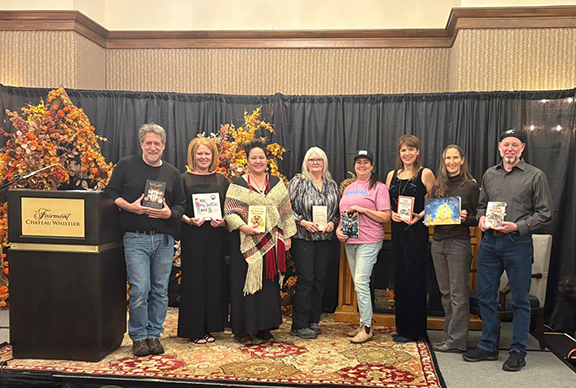
WIBA finalists, left to right: me, Lisa MacDonald, Carolyn Roberts, Diane Kirby, Robin Anne Ettles, Kim Hudson, Anna McCarthy, and Trevor Atkins

The main event was less than an hour later: All Hallows Eve: Murder and Mayhem. Sandwiched between improv sketches and an author panel conversation was the big reveal: the Whistler Independent Book Award winners.

When the award for fiction was announced, I fell immediately into a brief state of paralysis:

“And the winner is: Day of Epiphany, by Jerome J Bourgault!”

I don’t remember much else after that, except for a sudden and steady flow of congratulations, a lot of warm smiles and hugs, and much later on—after book sales and signings in the lobby— being unable to find a place to eat after 10:30 on a Friday night. We ended up splitting half an Oh Henry! and half a KitKat bar in the hotel room.

Saturday morning, another quick breakfast—by the way, I challenge anyone to find a bad cup of coffee in Whistler—and back to the Fairmont for another reading event. The award winner from each category was invited to sit in on the corresponding panel and participate in the discussion. The fiction panel was moderated Antonio Michael Downing, host of CBC Radio’s The Next Chapter, and featured Clea Young, author of Welcome to the Neighbourhood, and Giller Prize nominee Eddy Boudel Tan, author of The Tiger and the Cosmonaut. And me! In addition to answering questions, I had to give another reading from my novel, this one a bit longer and without the preamble. Needless to say I had nothing prepared—remember, I wasn’t supposed to win—so I’d spent the late hours the previous night and that morning scrambling for something appropriate. I settled on what I consider to be the very soul of the novel—if you’ve read the book, it’s Cassandra’s speech toward the end about cruelty; a heavy read but it’s the very essence of the book, and it was very well received. If anyone in the audience still didn’t know what Day of Epiphany was all about at its core, this explained it.

Fiction panel, seated left to right: Antonio Michael Downing, Eddy Boudel Tan, me, Clea Young.
Photo credit: Joern Rohde Photography

Then, before I knew it, it was over. We sold a few more books after the last reading, then spent the rest of the day wandering around town, visited the Whistler Art Museum (a must-see!), and collapsed after an exquisite dinner at the hotel brasserie.

It was an unforgettable experience! The people of Whistler were perfect hosts, and they are rightfully proud of their town and of their writing community! I’ve taken home some great memories of my time there, and having sold a few copies of both of my novels, I know part of me will remain.

Finalist (x 2)!

Welcome back, cherished readers!

It’s been a long time since I’ve shared anything in this space. Spring sort of came and went as I busied myself with entering Day of Epiphany in a number of award competitions, trying to drum up reviews, and beginning my 3rd novel (more on that in a later post), in addition to a whole lot of non-writing endeavours and obligations.

I thought I had reason to be optimistic: The Perpetual Now did fairly well, and I was entering what I believed was a superior book for many of the same awards. And so I waited… And waited…

Then, on June 3rd, I received word from the Whistler Independent Book Awards that Day of Epiphany had been named to their Shortlist for Fiction! Now, I’ve seen shortlists before; depending on the award, they can include upwards of a dozen titles. This was a total of six! Nor were there any sub-categories, beyond Fiction, Non-Fiction, and Children’s books. Of course, by then I’d learned to be cautious, and seeing as there was already a lot going on at the time, I thought I’d wait out the six weeks until the finalists were named.

It was worth it! On July 18th, I learned that my novel was named as a Finalist, along with two other titles! The winners will be announced during the Whistler Writers Festival, from October 30th to November 2nd.

Colour subject to change in November

Amid all this, word came on June 19th that Day of Epiphany was also named as a Finalist in the Historical Fiction category for the National Indie Excellence Awards, along with seven other titles. You can find it here: https://www.indieexcellence.com/19th-annual-finalists

There are still a number of other awards to be announced, most notably the Canadian Authors Association Fred Kerner Book Awards (winners and finalists to be announced sometime this summer), the Readers’ Favourite Annual Book Award Contest (September 1st), the Readers Digest Self-Published Book Awards (October 17th), and my old friends the Best Indie Book Awards, or BIBAs (November 30th).

Next up: musings on novel #3…

Writing about writing: English for French… in Québec… in the 1950s

A unique aspect of Day of Epiphany, which I never had to consider before, was the temporal and cultural distance between myself and the characters I was writing for. This is an English language novel intended for an English speaking audience, but it’s set in 1950s Québec. Unless specifically indicated (three or four scenes in particular) the characters would of course be speaking to one another in French throughout the novel. How to deal with that? Do I address the question at all? The best solution I could come up with was to make the narration, and the dialogue in particular, as natural as possible. As much as I could, I avoided the inclusion of French terms, unless there was no appropriate or better term in English. For instance, at the beginning of the first chapter, I make reference to a père prédicataire (an itinerant preacher), and I use the term curé (parish priest) a fair amount throughout the book as well. These were French terms that I thought important enough for the reader to learn. On the other hand, as tempting as it may be I never make use of the expansive Québécois lexicon of colourful curse words (tabarnak, câlisse, ostie, Crisse, trou de cul, bâtard, etc.). Instead, when my characters need to curse or call someone a nasty name, they do so in English. To do otherwise would be the written equivalent of the tired trope of countless Hollywood war movies, as when German soldiers speak to one another in English with German accents. 

Then, once I’ve committed to writing in English, I had to ensure that the language was consistent with the period, i.e. the 1950s. I recently read a scene from a novel that takes place in the 1980s, in which a character uses the expression “a big ask.” Having lived through the 1980s, I can promise you that NO ONE ever said “a big ask” when meaning “a lot to ask for.” Reading an expression so clearly from the 21st century in a scene from the ‘80s diminished the authenticity of the book for me just a bit, and I had no intention of making that kind of mistake in my own novel, whether the characters are ostensibly speaking French or not. 

At the same time, I deliberately avoided the use of ’50s era vernacular, simply because—rightly or wrongly— I identified it too closely with American popular culture, which felt out of place for for a story set in Québec. I did however use a couple of terms —namely “darwinists” instead of “evolutionary biologists” and “Mohammedans” instead of “Muslims”— that I felt would be appropriate for the period, especially by members of the clergy.

Publication is now days away. I’m spending the remaining days going over (and over and over) the print-ready files for final approval. As usual for me at this point in the process, I’m feeling both elated, excited, and scared shitless!

I wouldn’t want to hazard a guess as to how many times I’ve read Day of Epiphany in the past four months, and I’m happy to say that a) I’m more than satisfied with the quality of the writing, and b) I haven’t found any new typos of late. I’m trusting that you, my faithful readers, will find any remaining mistakes once the book comes out. We’ll know soon enough!

About the epilogue…

One of the casualties from my editing frenzy of The Perpetual Now in 2019 was a scene that involved an exchange between my protagonist, Justin Lambert, and his elderly neighbour Mr. Lovato. In it, Lovato recounts an anecdote about the town of Ferguston and its history of “small-town justice.” While he doesn’t come straight out and promise that the perpetrator of Elise Lambert’s disappearance will be brought to justice, he does suggest that such things have a strange way of balancing themselves out, at least in Ferguston. 

I loved the scene for the colour and depth that it provided—besides the fact that it’s a great bit of storytelling, in a Stephen King-ish kind of way— but at 2 000 words it was far too long to keep considering it didn’t exactly move the plot forward, and cuts had to be made. So, while it didn’t make it to the final manuscript, the scene was preserved in a scraps folder, where all kinds of cherished but unusable bits reside, waiting for some future application.

That happened sooner than I expected. Funny thing about writing: things are revealed to you as you write, be they aspects of a character’s personality, their motivations, their back story, an entire sequence of events, the sudden appearance of someone new, you name it. It almost feels as if the writer is indeed a spectator to the actions in the story, and not the creator. It’s weird. The first time I ever experienced this was during the writing of The Perpetual Now, when Justin witnesses a horrific automobile accident only a few meters away. It became a pivotal part of the story, but I originally had no real plan for it: it just kind of “happened.”

The same thing occurred—more than once, as I think about it—with Day of Epiphany. One of my main characters began to evolve—or should I say “began to reveal themselves”—in a way that made me think of that beloved thrown-away scene from The Perpetual Now, which suggested a very interesting and appropriate fate for the character in question. And, best of all, there would be no need to adjust any part of the scene. The fact that it takes place in 2006, while the brunt of the action in Day of Epiphany takes place between 1950 and 1959, offers a very different—and refreshingly modern—perspective, and gave me the opportunity to connect the two novels in a very unexpected way.

Will the Epilogue cause confusion for people who haven’t read my first novel? Maybe, possibly, initially. It takes place 47 years after the closing events of the novel, and involves two characters whom—with the exception of a single fleeting mention of one of them—the reader hasn’t yet encountered. HOWEVER, I do have faith in the intelligence of my readers, and as they read through it and the narrative connection is revealed, they’ll see the relevance. Also, given the depth of the storyline suggested in these few final pages, hopefully the reader will be intrigued and want to learn more and read The Perpetual Now (I’ve only written the one other book so it shouldn’t be hard to figure out where it came from). And it will be a bit of a treat for those who have read the first novel who will recognize the context immediately.

I’m SO looking forward to your feedback on this and so many other things when the new book is published. Things are really moving, so it shouldn’t be too long!

More to come!

Genesis of a novel: how Day of Epiphany came to be

As early as December, 2018, I’d begun to throw together ideas for my second novel. The Perpetual Now was still over a year away from publication — at this point, it was still a bloated 4th draft that was far too cumbersome to attract any serious consideration from publishers — and I knew I wanted to tell a different kind of story for my follow-up novel, one more rooted in history. 

Over the past few years, I’d been developing an interest in Canadian history of the 1940s and ‘50s, an era when my own parents were in their teens and twenties. Their shared memories of this period had long been incubating in my mind, and while it was never going to be a biographical work, I thought the new novel could be a place where many of their stories might find a voice and live on, while contributing generously to the detail of the picture I wanted to paint. 

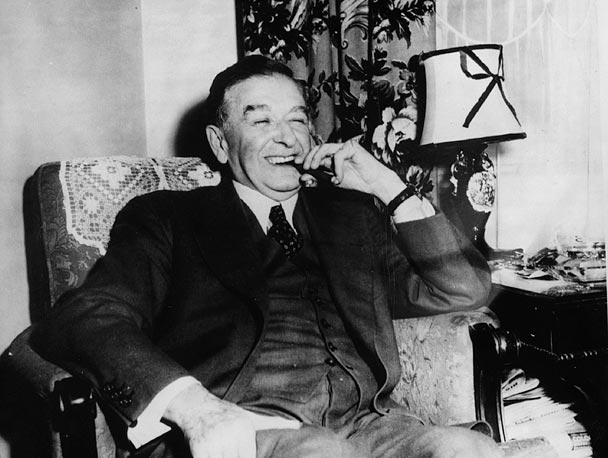
As I threw myself into researching the social history of the period, one name dominated from the start: Union nationale party leader Maurice Duplessis.

this guy

(Credit: Library and Archives Canada / C-031052)

I didn’t know much about Le Chef initially, except that he was premier of Québec for the better part of 20 years, and that he was immensely influential. What they didn’t teach us in high school was his dubious legacy. First, the Duplessis era itself came to be known as La grande noirceur—the Great Darkness—a period of extreme conservatism, sluggish economic growth and stifled cultural development. Second was the scandal of the Duplessis orphans, thousands of children whom he allowed to be deliberately misclassified as mental patients in order to qualify for federal subsidies earmarked for psychiatric hospitals. It was an incredibly compelling and tragic episode which I quickly discovered was largely unknown in English-speaking Canada. I decided this was to be my historical setting. 

Next, the plot. If the story was to be set in 1950s Québec, the Catholic Church would obviously play a central part, one way or another. The Church had a stranglehold on all matters pertaining to social programs, health, and education in the province, and had the full support and protection of the the premier. It was then that I remembered an idea first suggested to me waaaaay back in the ’80s by one of my oldest friends and most valuable collaborators: what happens when a parishioner confesses to a priest in church to committing murder? And what if this person was him/herself a member of the clergy? It was an intriguing plot idea, and forty years later an altered version of it would serve as the opening sequence of my novel. 

In its early iterations, the book that would become Day of Epiphany looked more like a straight-ahead mystery, using the Duplessis era as a backdrop. But as I read more about the period and the tragedy of the Duplessis orphans in particular, it became increasingly important for me to tell more of that story. Aside from Joanna Goodman’s excellent 2018 novel The Home for Unwanted Girls, the subject of the Duplessis orphans has barely been touched in English-language fiction.

Eventually, as it grew in the telling, the novel would focus primarily on the abuse suffered by the children at the hands of nuns and medical staff, and the increasingly desperate efforts of one nun to protect them. No, it’s not an easy book.

Remaining true to its original vision, there is still an element of mystery to Day of Epiphany; call it a historical fiction/mystery cross-over. It is also loosely connected to The Perpetual Now —some people and places will be familiar— and while it doesn’t really delve into the realm of science-fiction, Day of Epiphany resembles its predecessor in that it starts off as one thing, and then—quite subtly—becomes something else entirely. 

More to come…