

As you may remember, Day of Epiphany was named a finalist for the Whistler Independent Book Award (WIBA) for fiction back in July. It was such an honour for my novel to be counted among the top three fiction titles that, as far as I was concerned, I’d already won.
The awards were to be announced during the Whistler Writers Festival, at the Fairmont Chateau Whistler at the end of October. There was never any doubt that I would attend. I’d never been to Whistler, my conjointe and I were in need of a holiday, and I still had a 33.3% chance of coming home with an award. Any way you cut it, it was going to be fantastic experience. Win/win/win!
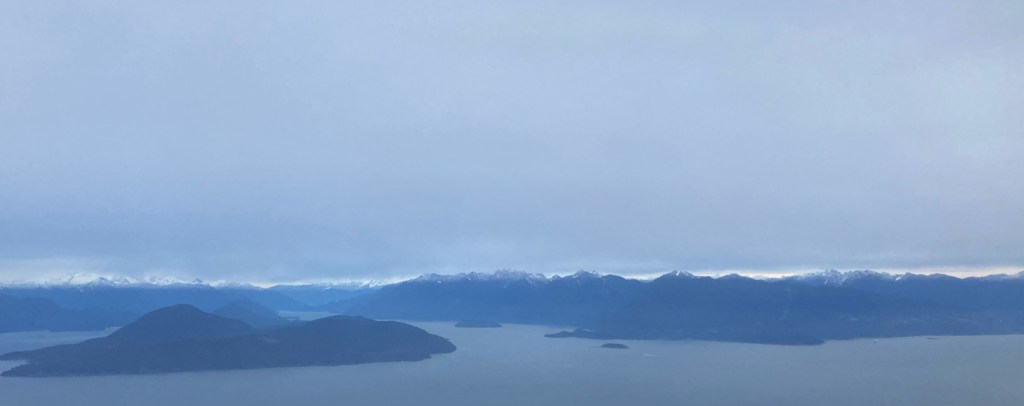
We arrived in Vancouver on a rainy Tuesday morning, spent two days exploring the city, the parks, the markets, and every single meal was excellent! The drive to Whistler on Thursday evening was mostly in the dark, so the spectacular scenery of our destination wouldn’t be revealed until the next morning. It was worth the wait!
Friday was the big day. It began with a workshop called Publish Like a Pro. Extremely helpful: made me wish I’d taken it two novels ago. Then a delicious lunch event with the other finalists at the Squamish Lil’wat Cultural Centre, then back to the Fairmont where the finalists from each category were invited to give a brief talk and a reading from their nominated work before a packed house. Cue butterflies!
Everyone was so brilliant that within minutes I’d convinced myself that there was NO WAY I was going to take home the award. Cue impostors syndrome!
I was scheduled to read fourth. It was a very upbeat affair and the hall was just buzzing, so not wanting to bring down the whole room, I chose to read as happy a section as I could find in my dark novel (not an easy task). I decided on a section where the young orphans commandeer a wheelchair and take turns racing around the common room of the institute. It’s a moment of joyful rebellion and it received a warm response from the audience, but I still felt badly out-classed. Ah well, it was an honour just to be there. Right?
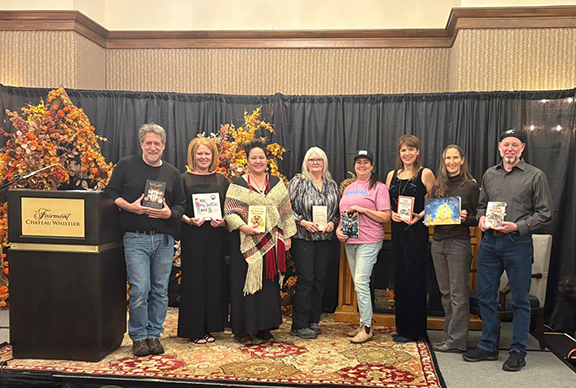
The main event was less than an hour later: All Hallows Eve: Murder and Mayhem. Sandwiched between improv sketches and an author panel conversation was the big reveal: the Whistler Independent Book Award winners.
When the award for fiction was announced, I fell immediately into a brief state of paralysis:
“And the winner is: Day of Epiphany, by Jerome J Bourgault!”
I don’t remember much else after that, except for a sudden and steady flow of congratulations, a lot of warm smiles and hugs, and much later on—after book sales and signings in the lobby— being unable to find a place to eat after 10:30 on a Friday night. We ended up splitting half an Oh Henry! and half a KitKat bar in the hotel room.
Saturday morning, another quick breakfast—by the way, I challenge anyone to find a bad cup of coffee in Whistler—and back to the Fairmont for another reading event. The award winner from each category was invited to sit in on the corresponding panel and participate in the discussion. The fiction panel was moderated Antonio Michael Downing, host of CBC Radio’s The Next Chapter, and featured Clea Young, author of Welcome to the Neighbourhood, and Giller Prize nominee Eddy Boudel Tan, author of The Tiger and the Cosmonaut. And me! In addition to answering questions, I had to give another reading from my novel, this one a bit longer and without the preamble. Needless to say I had nothing prepared—remember, I wasn’t supposed to win—so I’d spent the late hours the previous night and that morning scrambling for something appropriate. I settled on what I consider to be the very soul of the novel—if you’ve read the book, it’s Cassandra’s speech toward the end about cruelty; a heavy read but it’s the very essence of the book, and it was very well received. If anyone in the audience still didn’t know what Day of Epiphany was all about at its core, this explained it.

Photo credit: Joern Rohde Photography
Then, before I knew it, it was over. We sold a few more books after the last reading, then spent the rest of the day wandering around town, visited the Whistler Art Museum (a must-see!), and collapsed after an exquisite dinner at the hotel brasserie.
It was an unforgettable experience! The people of Whistler were perfect hosts, and they are rightfully proud of their town and of their writing community! I’ve taken home some great memories of my time there, and having sold a few copies of both of my novels, I know part of me will remain.

 So I wrote this novel...