Origins: part 1

This was a tale that grew in the telling.

I suspect that must be true of most, if not all, works of fiction: I can’t imagine one that is born fully-formed. Rather, a seed of an idea somehow germinates in its creator’s mind and, being just interesting or unusual enough to merit attention and not tossed onto the creative compost heap, is tended on a regular basis to grow beyond any recognition of its original (or even intended) shape.

That’s certainly what happened with me. My novel was born out of a mere fragment of an idea, barely a thought exercise, sometime in 2011. I spontaneously cobbled together something of a fairy-tale, playing it over in my head one sleepless night, an odd boy-meets-girl fable in which the narrator is confronted with something so utterly beyond his experience and comprehension that he can barely describe it, let alone attempt an explanation.

“Describe the indescribable”. Far be it from me to set easy targets for myself, right?

[Of course, the novel would likely have died right there in its larval stage without the endless love, encouragement and selfless generosity of my partner, to whom I’ve dedicated the novel. ¡Infinitas gracias, mi amor!]

The encounters between my two protagonists were originally very innocent, sweet and whimsical. I was tutoring young kids in French at the time and was using Saint-Exupérey’s Le Petit Prince as a teaching tool, so I suppose it was very near the surface as my own tale was coming together. Exchanges between my central figures, Justin and Billie, were replete with “Why is the sky blue?” -kind of reflections. If the novel had been published in those early days, it would have been a children’s book, with a hard cover the dimensions of a vinyl LP, lavishly illustrated in watercolours and pastels.

But, as it turns out, I’m not that kind of writer.

When I began committing my story to… paper (pixels?, bytes?), I’d set the age of my narrator to about 12 years. That lasted about 5 or 6 chapters before I realized my voice wasn’t going to lend itself (not convincingly, anyway) to that of a child, even a precocious one like Justin. So I barrelled on ahead, changing the voice mid-stream to that of an adult looking back on the events of his childhood. By then the narrative had acquired a crime mystery subplot, and the geographical setting took on a distinctly rough and seedy quality: Ferguston, Ontario, was born. When I went back to review the beginning, the contrast was startling, and adjustments had to be made. The tone had evolved to something more like Saint-Exupérey-via-Stephen-King.

Research was done on the fly. If I’d followed my natural instincts to get all my ducks in a row and conduct all my research before getting started, I never would have gotten past the dedication. When I felt out of my depth and needed more insight than could be provided by a Google search, I consulted doctors, police, and psychologists. When I needed to refresh my memory of the region and get a more palpable feel for the world I was creating, I went for a drive.

During one of these forays in September, 2015, I lingered for a short while in Parry Sound, a small lakeside town on Georgian Bay. That is where I found my Ferguston, or rather what Ferguston might be without out all the anger, crime, and despair. The resemblance to the town I’d envisioned was striking: even the cemetery was similar, down to the giant pine trees and the older, less-tended section with headstones from the early 20th century. Funny thing, I had already described these and other details in the novel long before I ever set foot in Parry Sound, which made this discovery all the more startling. Other details, namely the huge 32m high railway trestle, which didn’t quite fit into my vision of Ferguston, found a home in another fictional locality in the story.

Pieces were coming together: I had a general tone for the novel, the basics of a story-line that included an as-yet embryonic crime mystery, and a clear idea of the physical setting where all this was taking place.

Time to start making people.

A Word About Words

Today I’m writing about writing, which I suppose is marginally more entertaining than talking about talking.

I’m going to stop short of calling this an all-out rant. While I do have strong feelings about what I want to express, rants aren’t known for being particularly introspective, nor are they characterized by conflict or recognition of an alternative view. As I write this, I’m in a quandary.

I want to talk about words. I am a self-professed word nerd and borderline grammar nazi. Words are my stock-in-trade, the fundamental building blocks of my profession, the very cells that make up the organisms I give life to. While I’m not much of a purist in other areas, I’m very protective of words. I choose them carefully and judiciously, which I guess explains why it took me over five years to write my novel. But I digress.

When I’m writing, I’m filled with a giddy exhilaration over the creative potential of words. They’re like the coloured wax crayons I used to get as a kid, the ones packaged in an orange box with a green lid, and for some reason always came in multiples of 8. The more colours the better. Later, coloured pencils replaced the wax crayons, in turn supplanted by marker pens, replaced at their turn by the colour palettes in graphic software. What was most important to me was the diversity and range of hues. I wasn’t content with 2 or 3 shades of blue: I wanted 20. The greater the array of colours at my disposal, the more precisely and accurately I could convey the image in my head, and this was essential for someone who lived by the principles of nuance and subtlety. Hell, I’d have been happy with a box full of grey crayons, provided there were sufficient shades of them.

[I won’t argue here about the merit of art expressed through a limited palette: galleries and museums around the world are full of masterpieces that can be so described. It’s just not how my brain works.]

I feel the same way about words, but where this analogy breaks down is significant: colours don’t change. While there may be areas along the spectrum where differing interpretations are conceivable (is a particular shade of blue-green more blue than green?) the generally accepted interpretation of what constitutes blue isn’t about to be turned on its head. A new generation of artists isn’t about to come along and decide that what I always thought of as blue is now brown. These conventions are fairly stable and consistent across time and geography.

Not true of words. As an anthropologist, I’ve learned that language, like all other aspects of culture, is a dynamic, adaptive system. This is especially true of spoken language; the written version of it is by several degrees more static and struggles and lurches along trying to keep up. Words are born, they evolve, morph, and become extinct. They are constantly being made up, appropriated from other languages, their pronunciations altered, their meanings adapted and twisted to fit changing contexts, discarded whole sale, and sometimes even resurrected. This has been going on for as long as there’s been language, likely some 200,000 years, perhaps much, much longer.

And here’s the rub when it comes to all this change: people like me don’t have to like it. I can rant and preach until the next glacial advance about how multitudes of words are being misused; that when, for example, people say they feel “nauseous” they really should be saying “nauseated”; that “simplistic” is not the same as “simple” and shouldn’t be substituted for it (and that it certainly shouldn’t be used as a compliment); that the way “literally” is being used increasingly (as “figuratively”) is the precise opposite of its defined meaning; that one “pores”, not “pours”, over numbers in a ledger or details in a manuscript; or that “rude” means offensively impolite or bad-mannered and not just something that you don’t want to hear. Examples like these are legion, and each one makes me die a little bit inside, each one a single paper cut that together over time will bleed me dry.

I can make a plea to authority and draw my trusted Webster’s or OED like Excalibur, brandishing it before the linguistic heathen to bestow upon them the righteous light of “the correct meaning”, and I often do (though nowadays it’s usually the on-line editions). But the thing is, once the number of people “misusing” a particular word in the same way reaches a critical mass, it’s tough noogies. I could say “But it’s not in the dictionary!!!!” but the simple, inescapable retort to which I have no intelligent rebuttal is “Then it’s time to change the dictionary.”

Revisiting my original analogy, perhaps a more healthy perspective would be that words aren’t like coloured pencils in a box: they’re more like your children. As much as you love them, it can sometimes be difficult to watch them grow, mature, change before your eyes, while you watch helplessly from the sidelines. Sure, most of them will evolve in directions that you can accept and live with and continue to love. But sometimes they’ll quit school, get their tongue pierced, and run off with a bass player in a death metal band.

Irregardless of your feelings.

misuse

A Distinctly Nasty Place

J.R.R. Tolkien had Bree, Esgaroth, and the Shire in Middle Earth; Kurt Vonnegut had Ilium, New York; Stephen King has Derry and Castlerock, Maine; and John Grisham has Clanton, Mississippi.

My friends, I give you Ferguston, Ontario.

One of the great many perks of being a fiction writer, I’ve discovered, is worldbuilding (yes, it’s one word), otherwise known as playing god.

From the very beginning, even while the story was still gestating, I knew I wanted to set my novel in a northern Ontario town. I have some personal history there: I know the landscape, the people, the politics. But because my town was going to be a distinctly nasty place, with more than its share of anger, violence, intolerance, and economic stagnation, I knew I couldn’t use an actual existing community that anyone could find with a quick Google search. It also needed to be relatively small because I wanted the distinct character and colour of a modest northern hamlet — the kind of place where everybody knows everybody else’s business — but large enough that the action of the story could be easily contained within its borders. Finally, I wanted to give it the distinctly francophone flavour that I grew up with.

Thus was born Ferguston, Ontario (population 10,070), vaguely located somewhere in the northeast part of the province, on the eastern edge of Lake LeClair (… don’t bother Googling that one either). The novel includes a few hints and landmarks: it’s within an hour and a half drive from Sudbury (in which direction isn’t revealed); there’s passing mention of Nipissing and New Liskeard; and there are plenty of French surnames and place names. That’s all I’ll say. If you’re familiar with that part of Ontario, you’ll know its topography: a sparsely populated, rugged territory of lakes and mixed forest and Precambrian rock. Four-lane highways are virtually non-existent, and Internet and cell phone service (especially in 2006, when the story takes place) is intermittent at best.

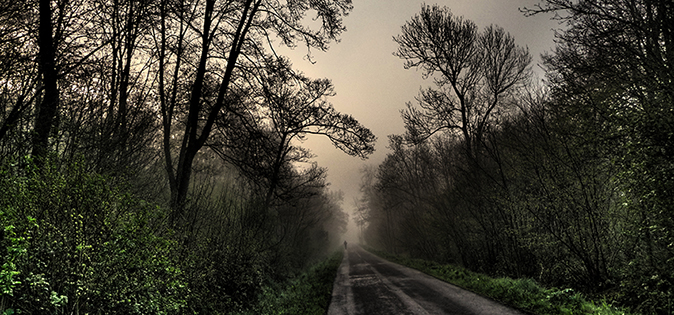
DarkRoad_sm

(You might want to turn around, folks…)

While this may describe any number of towns and villages in the north, Ferguston is “special”, in the way a paranoid sociopath is “special”. Ferguston is northern Ontario’s drunk uncle. Justin (my narrator) describes it to his friend Billie this way: “There are worse places, I guess, but if this isn’t the armpit of the province, it’s in the same area code.“

Being situated in a natural depression, stuff has a tendency to roll, slide, or slither down into Ferguston, and not much of it is good: damaged people and creatures of all kinds, sketchy businesses, obsolete furniture and machinery, arcane belief systems, faint hopes, bloated ambitions, and unrealistic expectations. Most never find their way out again. A lot more nastiness is born and festers there, mutating into unrecognizable forms, content to lie in wait under the ooze for an unsuspecting victim to drift too close.

There is a signature soundtrack to northern Ontario: it includes the lonely call of trains, the pealing of church bells, the manic cry of loons, the caw of crows, and the whir of small engines. In Ferguston, you’d have to add the wail of police and ambulance sirens.

Ferguston is not a happy place. There’s a subtle, insidious ugliness that lives there, like a bad smell only less distinct. It’s in the air, like the particles of soot that used to float around during the coal age. After a while, residents begin to wear it on their bodies without noticing: there’s a heaviness in the way they walk, a shortness of temper, an inherent suspicion of others (neighbours and outsiders alike), a habit of criticizing and complaining about everything, and a resignation to mediocrity. In Ferguston, people snip and snap at one another, nice things get trashed, and broken things stay broken.

I’ve often thought that if Ferguston were to have an official logo, it would be an upraised middle finger.


*****

Stop me if you’ve heard this…

Two long-running jokes about Ferguston that are particularly revealing:

1) On the paradox of having a remarkably stable population despite a notorious teen pregnancy problem: every time a young girl gets pregnant, some young guy leaves town.

2) On the inability of local law enforcement to solve crimes: everyone has the same DNA and there are no dental records.

Nine things I learned about writing a novel

  1. Characters will do whatever the hell they want and get a writer into all kinds of trouble if left unchecked. My job is just to keep a detailed record of what they’re doing and reel them in when they start going crazy (I can always edit later).
  2. As a writer, I spend 90% of the time on my novel just thinking about it; 5% is actually spent writing and the remaining 5% is spent trying to remember all the brilliant ideas I was too stupid, sleepy, lazy, or forgetful to jot down.
  3. Creating a map of my fictitious location turned out to be an indispensable tool, even if I eventually decide not to include it in the final work. Ditto for a timeline.
  4. NO WRITING IS WASTED (part 1): Some of the writing I love the most (though not necessarily my best) gets deleted in the interest of advancing the plot; however, that doesn’t keep me from saving the deleted bits in a separate folder for later.
  5. NO WRITING IS WASTED (part 2): When first getting started, I found the single most important part was putting something on the page, anything, no matter how bad it sounded initially. You can’t improve, enhance, or edit a blank page. Even if I ended up trashing it, at least I initiated some kind of process.
  6. Whether out of excitement, impatience, naiveté, or ego, I learned the hard way to never EVER show anyone your first draft (with apologies to those who’ve read it). As Terry Pratchett said, “The first draft is just you telling yourself the story.” A novel will never be worse than in its first draft form.
  7. You always hear “Write what you know.” I’ve found, rather, that it’s more important to write what you love. Even if you don’t know that much about a subject when you begin (and you probably don’t know half as much as you think you do), you’ll learn a lot as you go if you’re passionate about it.
  8. When someone says that something about your story doesn’t work, they’re usually right. When they give you suggestions on how to fix it, they’re invariably wrong.
  9. It’s not your job as an author (or any kind of artist, for that matter) to please everybody, or to be everything to everyone (… unless you’re the CBC). Write YOUR story as truthfully and honestly as possible, and don’t apologize. Whether it pisses somebody off is a secondary concern.

typewriter

(no, this isn’t my laptop)

Friday fallacy

Those of you who received my Facebook invitation to this blog were promised (along with details about my novel and musings about writing in general) “rants, ramblings, and momentary distractions” on all manners of “amazing, fucked up, or fall-on-your-ass stupid shit” that’s too juicy to ignore.

Far be it from me to go back on my word.

I am therefore delighted to present you with “Fall-on-your-ass-stupid shit”: the inaugural edition.

Today’s little nugget of nonsense seems to surface every August on social media. The claim is that on August 27 (three days hence), Mars will appear as large as the Moon in the night sky. Amazing, huh!?!

Ummm… no.

The rumour was born out of an actual celestial event in 2003, and ludicrously exaggerated. Every 15 years, Mars’s orbit brings it closer to Earth than at any other period, roughly 54.6 million kilometres (at its furthest, the red planet is just over 400 million km away, so that’s practically next door by martian standards). Back in ’03, it was closer than it had been in some 60,000 years (marginally closer than previous cycles, but still), and skywatchers everywhere went nuts… or as nuts as skywatchers ever get. Of course, unless you had a telescope it was still just a reddish dot in the night sky, if only a slightly more prominent one than usual. Still, star gazers around the world were understandably excited: break out the old Tasco, find a dark open space far from the city lights, point your lens at the right spot, and fill your hearts with bright orange loveliness.

But what good is the Internet if you can’t use it to indulge in wild, unsubstantiated gossip that preys on readers gullibility and utter lack of critical thinking? Especially if you have access to Photoshop! An easily falsifiable rumour is born, people “oooh” and “ahhh” for a moment, make a quickly forgotten mental note to look out their windows on the date in question, and move on to the next story… like the beached squid the size of a house, or sharks swimming through flooded shopping malls.

Fast forward another 15 years, and the rumour cycles back again. Mars is closer now to Earth than it’s been since ’03, but it’s still bloody far. The Moon is 384,000 from Earth; at its closest, Mars is still over 140 times further away. Granted, Mars is twice the size of the Moon, but it will NEVER be more than a dot in the night sky to the naked eye. EVER.

11745411_877374272354258_213350263647337110_n

(I think the Death Star would have been more convincing.)

What’s it all about: On the subject of the subject of my novel.

Some of you have asked me what this novel is all about. A just question, and if you’ve agreed to accompany me on this journey, it’s only fair that I should share with you, dear reader, the basics of my favourite obsession for the past 5 years.

The tentative title is The Perpetual Now. Call it a coming-of-age-in-a-small-town-crime-mystery-with-an-underpinning-of-sci-fi story. (Oh no, not another one of those!!!)

The novel is set in the fictional Northern Ontario town of Ferguston (population 10,070). Ferguston is a hole in every sense of the word: small, intolerant, economically stagnant, often violent but otherwise never really eventful. It’s certainly not the place where you’d expect reality itself to get turned on its head. And when it does, it’s a lot to take in for a 12 year-old.

Justin Lambert is a bookish, introverted son of a local school teacher, and a bit of a celebrity for the wrong reason: like it or not, he’s connected to the biggest unsolved mystery in Ferguston’s checkered history. Justin’s mom vanished a decade ago while driving home from a dinner party, leaving an inconsolable husband and young son behind. Most townsfolk (Justin’s dad, Martin, included) have had good reason to suspect foul play; they even have a potential culprit in mind.

Fast forward nearly 10 years, and during an unusually hot summer peppered with random bouts of head-shaking weirdness, something is happening in Ferguston. After a decade of watching his beloved dad spiral slowly into despondency and quiet resignation, Justin stumbles over fresh evidence that may finally resolve the painful mystery of his missing mom. Re-energized by this discovery, father and son eagerly pursue every lead they see (of think they see) in the hope of uncovering the three things that have eluded them all these years: a final answer to what happened 10 years ago, justice for those responsible, and a sense of closure.

Looming over their shoulders is notorious local trouble-maker and wannabe gangster David Raymond (or D-Ray, as he calls himself), for ten years the one (unofficial) suspect in the disappearance. Now his name is being whispered around town again, and he’s is pissed about it. D-Ray is a violent, damaged person with a nasty temper and dangerous connections, and he has the Lamberts squarely in his sights.

Finally, thrown into the mix is a strange little girl named Billie. Justin isn’t sure at first if Billie is gifted, severely challenged, or just looking for attention, but she’s a much-needed friend and ally in a town where they are few and far between. She also has an awfully big secret which, when she reveals it to Justin, is nothing short of earth shattering, and changes Justin’s life and worldview forever.


That’s the gist of it; I could see a shortened version of this on the dust-jacket. Meanwhile, I’ll be posting the occasional excerpts, out-takes, and stuff about my research (with pictures!) in the weeks to come, so stay tuned.


book-1568672

(insert image of open book and mandatory reading glasses here)

I guess I have to write something now…

Oh shit! Now I’ve done it.

My novel is finished. What the hell do I do now?

Maybe I didn’t think this all the way through.

Dammit.

For five years I was perfectly happy to follow my characters around on their adventures, occasionally intervening whenever they got too crazy, too inconsistent, too off-topic, or just too boring, and dutifully recorded all their thoughts and actions. Now, having done all the reasonable tweaking I can, poring over grammar, even adding a deliciously devious plot twist at the very end, I’m finished. If I were in kindergarten, this would be the moment where the art teacher would be taking away my gouache painting before I ruined it. It’s DONE.

So now what?

This is where things get complicated. See, I’ve never had anything published before. Well, certainly not a work of fiction, let alone a 300+ page novel; the one and only bit of published writing I can take credit for is a companion document to a permanent exhibition at (what was then) the Canadian Museum of Civilization. That was in 1991.

So what have I been doing in the meantime? That, my friends, is for another entry.

Suffice to say that for now I’m in unchartered territory. I’m on that part of the map where (at least as far as I’m concerned) fantastical creatures lurk and there are notes in the margins claiming “Here be dragons.”

I’ll let you in on a secret, if you promise it won’t leave this room: I’m not a trained author. I never went to author school. I had a story I wanted to tell, I figured I sort of had it in me, that I’d always had some ability to stitch sentences together, and (mostly) nobody told me I couldn’t. I never read any of the guides, the “how-to”s, the step-by-step recipes of how to write a novel for fun and profit. If I had, I doubt that I would have started this thing in the first place. I originally approached acting the very same way: never went to theatre school or took acting classes, just launched myself in feet first (“Shit, I can swim and the water looks deep enough: let’s go!”).

So the long and the short of it is I’m not published, I’m not represented, I have no experience, and (thus far, at least) I have no following that doesn’t have some familial obligation to support me. Hence this blog. I’m hoping that surely I’m not the only one in this situation. This whole Internet thingie was supposed to bring otherwise disparate people together into like-minded communities, no? Surely I’m not the only one who’s reached this point, so I’m hoping (if you’re out there) that you’ll connect with me. Meanwhile, I’m going to talk about my process, my discoveries, trials, gaffes, and hopefully the occasional epiphany, and generally rant and ramble about all manners of stuff.

And so we begin. Right now I feel very much like Bilbo Baggins, standing on my threshold, walking stick in hand, about to step onto a path that will take me who-knows where. Of course Bilbo was alone; I’m hoping you’ll join me, at least part of the way.

I hear there are dragons out there. I would dearly love to see one.

PeleePath